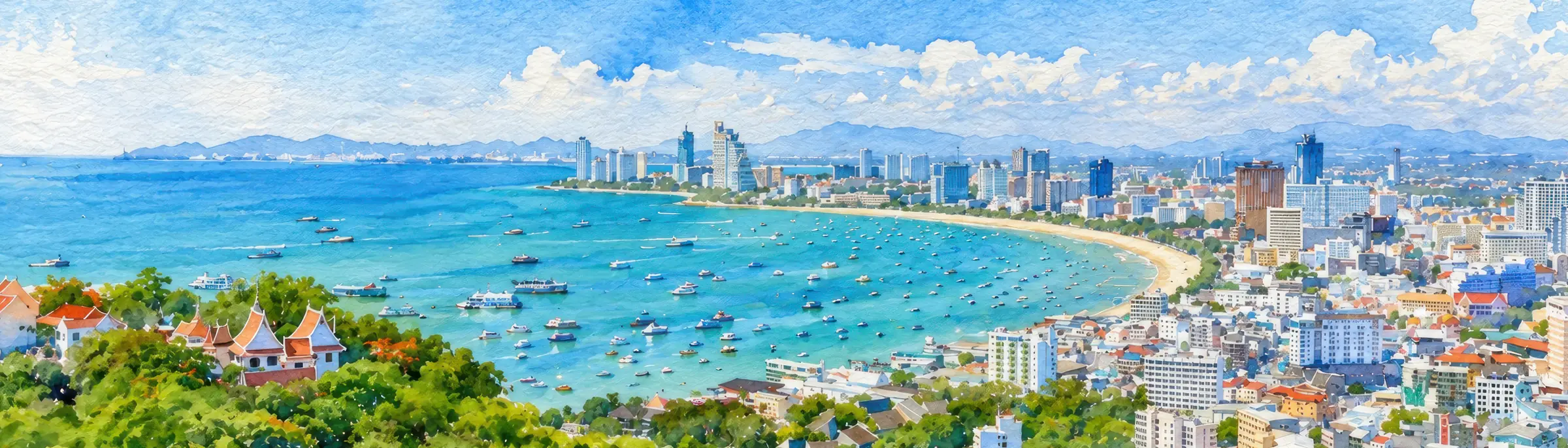
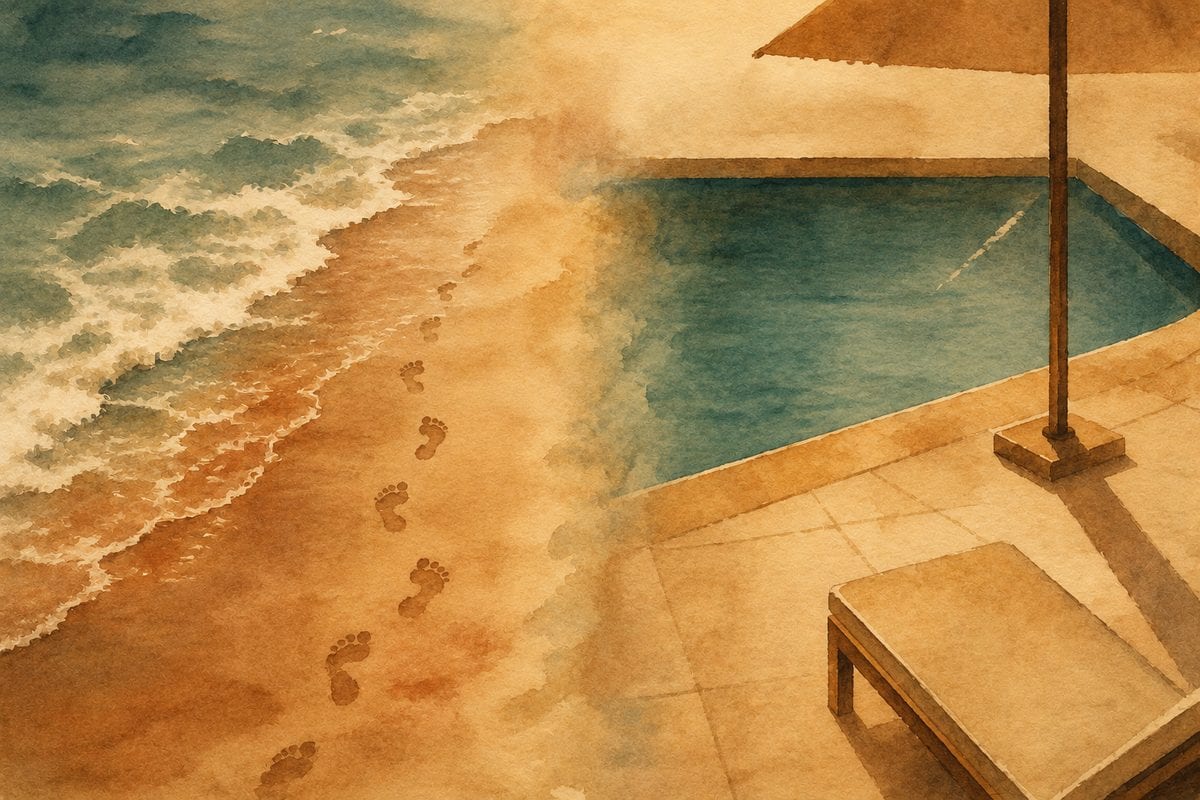
An open beach and a private pool are the two most common locations for family and couples shoots in Pattaya. On paper it’s a choice of backdrop. In practice these are two different ways of working, with different constraints, different light, and different technique.
Most clients choose between them by how good the shots look in someone else’s portfolio. That’s a poor guide. It’s better to go by what kind of shoot you’re planning, who will be in it, and which variables you’re willing to accept.
Jomtien Beach
This is one of Pattaya’s main public beaches, about 6 km from south to north. You’re shooting under open sky, the background is sea and horizon, and underfoot is dry, pale sand.
What works. Space. You can step back, change angles, let people move. The sea is a natural backdrop that needs no decoration. Morning and evening light is soft and even.
What doesn’t. During the day (10:00 a.m.–4:00 p.m.) the sun beats down, the sand bounces light up from below, and it’s hard to get the exposure right on both clothes and faces. On weekends and in peak season (November–February) the beach is packed with tourists, and getting a clean shot with no strangers in it takes real work.
What to keep in mind. Sand gets into clothing and shoes. Salt air coats the skin within twenty minutes. The wind never lets up, so there’s no point styling your hair in advance. With children, wet feet are guaranteed within the first five minutes.
Who shoots there. Vacation photographers: most of the beach shots in public portfolios were taken here. Wedding photographers come less often and tend to prefer the quieter shore in Naklua, at the north end of the city (around Cape Dara), or the beaches in front of hotels. Business portrait photographers almost never work here, because the backdrop looks too much like a vacation.
Best time. 6:30–8:30 a.m. and 5:00–6:30 p.m. (more on the best time of day to shoot in Pattaya). Shoot at midday only if you have no other option and the photographer knows how to work with hard light.
The hotel pool
This is a private area inside a hotel: a pool with loungers, sometimes with a sea view, sometimes in an inner courtyard. Pattaya’s big hotels (Centara, Hilton, Hard Rock, Cape Dara, Royal Cliff) have large, carefully designed pool areas.
What works. A controlled environment. You can shoot at any time of day, because there’s shade from canopies and buildings. The background is designed: wooden loungers, tropical plants, blue water. There are fewer strangers around if you pick a quiet time of day. A business portrait with the pool area as a backdrop works (if your field allows a lifestyle look).
What doesn’t. A commercial shoot at a hotel pool usually needs permission. If you aren’t a guest of the hotel, or the photos aren’t for personal use, you’ll have to arrange it separately. Guests are usually allowed to shoot without any trouble, as long as they don’t get in other people’s way. The light can be very contrasty: the sun over the water gives harsh glare, especially from 11:00 a.m. to 3:00 p.m.
What to keep in mind. A pool often bounces bright light up onto the lower half of the face, so the skin looks lit from below, as it does on white sand. The blue of the water affects the white balance: without correction, faces can come out slightly bluish. Loungers and umbrellas in the background are a common compositional problem; the photographer either works them into the shot as part of the setting, removes them, or shoots from an angle where they can’t be seen.
What gets shot there. Lifestyle shoots for couples are a common request. Then there are family photos with small children (the water is right there), corporate and marketing shoots for the hotels themselves, and “relaxing at the resort” sessions for social media or personal use.
Best time. Early morning (before 9:00), when the pool area is empty and the light is soft. Or late afternoon (4:00–5:30 p.m.), when the light turns golden and the warm tones begin to appear. Between those two windows the sun is high and the shadows are too harsh.
How to decide
Type of shoot. For a documentary family shoot, the beach gives you more candid moments (children in the waves, parents at the water’s edge). A styled lifestyle shoot is easier to control at the pool. For a business portrait neither is ideal, and a city location or a studio would be better; but if it has to be one of these two, the pool usually gives the more neutral background.
Children’s ages. Small children (ages 3–6) do better at the pool: the space is enclosed, the child can’t run off, and the parents are calmer. Older children and teenagers often do better on the beach, where there’s room to move and you can get lively shots in the waves.
Time of year. In peak season (November–February) the beach is packed; a hotel pool may be busy too, but you can work around that. In low season (May–October) the beach is emptier, but the risk of rain is higher. At a hotel pool the weather is always a manageable risk (most have a covered area).
Budget. Shooting on the beach is free. At a hotel pool you either have to be a guest or pay for permission (1,000–5,000 baht, depending on the hotel and the type of shoot). If you are a guest, most hotels allow a shoot for personal use at no charge, as long as you let them know in advance.
Logistics. On the beach you need somewhere to change (if you’re planning a change of outfit or shots in the water). A hotel pool usually has facilities right there, so you can work without logistical problems.
Common mistakes
Shooting on the beach at midday in full sun. This is the most common mistake. The light is too hard, skin washes out, and children get tired. If there’s no other slot, shoot in the shade (under a palm, under an umbrella, by a hotel wall) or use fill flash. The open beach at 1:00 p.m., with no preparation, gives you a weak set of photos.
Shooting at the pool with other guests in the shot. If the pool area is full, you can’t shoot there without having to retouch the background afterward. Come early, arrange for an area of your own (a hotel can often set aside part of the pool), or shoot in a corner where other guests stay out of the picture.
Treating the pool like a beach. A pool is a controlled environment, with architecture and design. Shooting there the way you would on a beach (wide, open, relaxed) often doesn’t work. It’s better to use the structure in the background: loungers as lines in the composition, canopies for shade, the pool’s edges as geometry.
Treating the beach like a pool. A beach is an open space with unpredictable variables (waves, wind, people, sand). Attempting a “styled” shoot there as if you were in a studio ends in frustration. It’s better to accept all that movement as part of the picture.
What to discuss with the photographer
Whether they know this particular location. Beach Road near Walking Street is different from Beach Road by the central beach: the crowds, the sand, and the angles are not the same. The Centara pool differs from the Hilton pool in both design and light. An experienced photographer knows the exact spots.
Whether they have permission to shoot (for the pool). If the pool belongs to a hotel you aren’t staying at, the photographer needs to have an arrangement with the hotel, or you’ll have to make one yourself.
What happens if the weather changes. On the open beach, rain means the shoot is canceled. At the pool there’s usually a canopy, so the shoot can go on. That affects how far the result can be guaranteed.
What public portfolios reveal
If a photographer’s portfolio has plenty of beach shots and almost none by a pool, they specialize in open locations and may struggle at a pool (reflections, limited space).
If it’s the other way around — lots of pool, little beach — they shoot lifestyle for the hotel industry or styled sessions for couples. On a real family shoot with children they may be out of their comfort zone.
If both are there and both are strong, it’s a good sign: the photographer works in different kinds of conditions. In Pattaya that’s rare.
The beach is alive, unpredictable, and open; the pool is controlled, styled, and contained. Which of them you need depends on what the shoot is for.