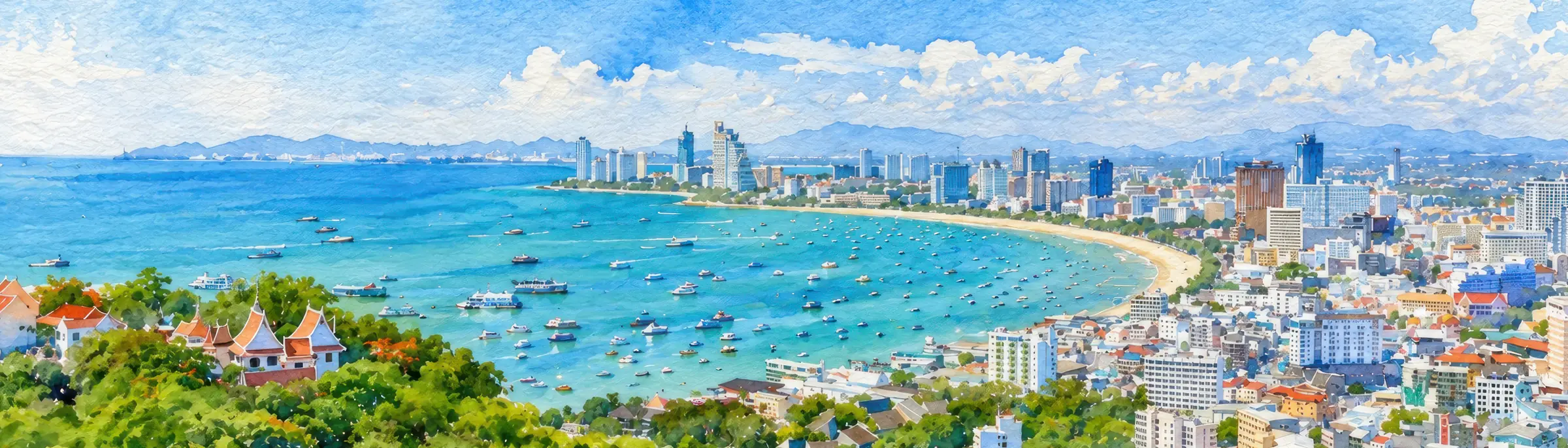
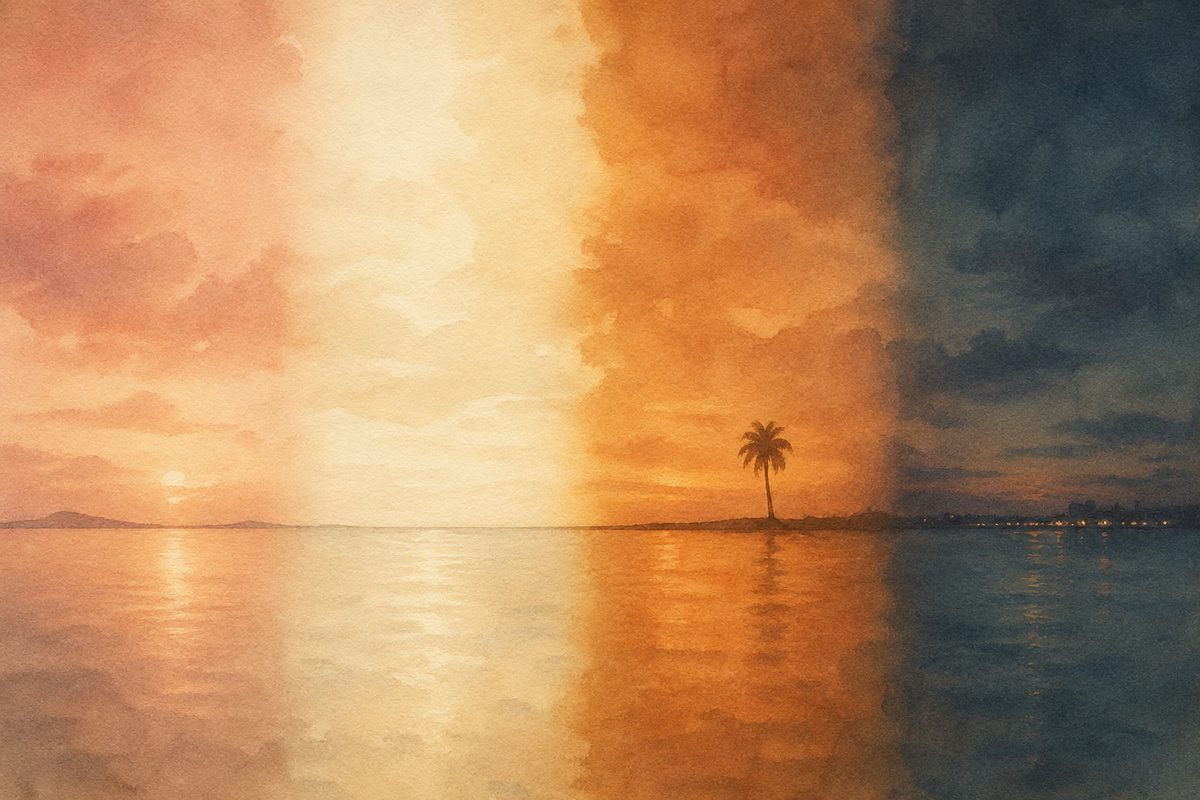
At Pattaya’s latitude of 12°, the day lasts about 12 hours all year round, give or take 45 minutes depending on the season. Sunrise is at 5:50–6:45 a.m., sunset at 5:50–6:50 p.m. Everything has to fit into those twelve hours of light, from weddings to family walks. Not all of them are equally good for a shoot.
The time of day determines three things: the quality of the light, how crowded the location is, and the physical state of the client. None of the three changes in a straight line. Golden hour gives soft light, but on a Saturday at Jomtien the beach is no longer empty even at 7:00 in the morning; midday gives harsh light, but at a villa in Bang Saray it is perfectly quiet at that hour; evening gives warm color, but by six a child who has spent three hours on the beach is in no state to be photographed.
Morning: 6:00–9:00 a.m.
Light. The softest light of the day. Before sunrise it’s blue hour: light diffused by the clouds, a warm horizon. From sunrise until about 7:30 it’s golden hour, with low sun from the east, long shadows, and clear light on faces. By 9:00 the light is already harsher, but it still works.
Crowds. Until 8:00 the beaches are practically empty. At Jomtien and Wong Amat you’ll find fishermen and the occasional lone tourist. From 8:30 tourists start arriving after breakfast. By 9:30 it’s crowded.
How people are holding up. The client is in the best physical shape of the day: fresh, not tired, not overheated. Children in particular are easy to work with in the first hours after breakfast.
What to shoot. Any couples or family shoot: this is the best time for it. Wedding getting-ready shots and portraits of the couple. A business portrait with the sea in the background (if that’s the kind you need). Morning meditation or yoga sessions.
What not to shoot. A wedding ceremony: the logistics usually don’t work (the guests can’t get there in time). Parties and dinners, obviously. Shots with neon lighting.
Downside. Getting up at 5:30 after a late dinner with friends. That stops a lot of clients, and subjective as the difficulty is, the photographer has to take it into account.
Midday: 11:30 a.m.–2:30 p.m.
Light. The harshest light of the day. The sun is almost directly overhead. Shadows are short and hard, sand and water bounce light up from below, skin blows out into highlights, faces look flat. For the details, see what the midday sun does to a face.
Crowds. The beaches are at their most crowded. Tourists have come out of their hotels after breakfast, and many stay on the beach until the siesta at 2:00.
How people are holding up. It’s 32–35°C with 65–80% humidity. Children start getting cranky after 20 minutes. Adults sweat, clothes look bad, makeup runs.
What to shoot. Only under special conditions: under an awning or in full shade; interior shoots (apartments, offices, hotels); a business portrait in a studio or an indoor location; silhouettes against the sun, if you have the technique for it.
What not to shoot. The open beach, a walk around town, children under 5 whatever the plan, a long wedding shoot.
Downside. Sometimes this is the only slot available: between breakfast and lunch, between excursions. Then the photographer has to cut the plan to 30–40 minutes at most and shoot in the shade.
Afternoon: 2:30–4:30 p.m.
Light. Harsh, but no longer coming straight down. The sun now comes from the west. Shadows lengthen and contrast is high. This window is underrated: it’s technically difficult, but it isn’t the disaster that midday is.
Crowds. The beaches stay crowded. Many tourists come back after a siesta at their hotels.
How people are holding up. The heat is at its peak. Many people are in “resting after lunch” mode and in no shape for a shoot. Children can be fresh if they’ve had a nap.
What to shoot. Indoor scenes. Getting ready for an evening event (a wedding, a dinner). Shoots that use the shade of buildings and palm trees. Business portraits in hotel lobbies or air-conditioned offices.
What not to shoot. Large groups on the open beach. Scenes with a lot of movement.
Golden hour: 4:30–6:00 p.m. (in winter 4:00–5:30)
Light. The best time of day for photographing people. Low sun from the west, a warm color temperature, soft shadows. On Pattaya’s west-facing shore (Jomtien, Wong Amat) the light falls on faces head-on, which is ideal for portraits. In the part of Naklua north of Wong Amat and on the northern shore, the sun drops out of sight a little earlier.
Crowds. At 4:30 the beaches are still crowded. By 5:30 they start to empty as tourists go off to dinner. Crowd-wise, the most comfortable moment is 5:45–6:00, while the light is still good.
How people are holding up. Refreshed after a siesta or a swim, and ready for the shoot. Children can be cranky if the day has tired them out; in the evening, couples and adults are easier to shoot.
What to shoot. This is prime time for everything. Wedding portraits of the couple. Family walks. Couples shoots. Engagement shoots and proposals. A business portrait with the sea in the background (if you want a lifestyle look).
Downside. The window is short: 60–90 minutes at most. The plan has to be ready in advance. If the photographer is “looking for a spot on location,” a third of the window is lost.
Blue hour: 6:00–7:00 p.m.
Light. The sun is below the horizon and the sky is still bright, but the warm color is fading. A blue tone comes into the sky and contrasts with the warm lights of the city. It’s a very beautiful combination, but the artificial light has to be balanced against the natural light.
Crowds. The city starts to come alive. Walking Street and the promenade fill with tourists at around 6:30–7:00.
How people are holding up. Fine. People are often relaxed after an early dinner, or looking forward to dinner.
What to shoot. Evening walks for couples. Shots with the city as the setting: streets, terraces, balconies with a view. Proposals on the pier. Wedding receptions (the opening part).
Downside. The window is shorter still: 30–45 minutes. Without a tripod or flash it’s technically difficult.
Night: 7:00 p.m. and later
Light. Artificial only: city neon, restaurant lamps, car headlights, decorative lighting. High ISO or flash is a must. Without the right gear, photographers end up with dark, noisy pictures.
Crowds. Walking Street and the central tourist streets are a solid stream of people. That can be an advantage (a lively background) as well as a problem (strangers in the shot).
How people are holding up. The children are asleep. The adults are relaxed, or have had dinner and drinks. Weddings move into their informal part.
What to shoot. Wedding receptions (dancing, toasts). Couples shoots in town for the look of the city at night. Corporate events. Concerts, shows.
What not to shoot. A family with children. A business portrait (unless it’s for a specific niche such as the nightlife business).
Adjusting for the season
Sunrise and sunset times in Pattaya shift by up to 30 minutes either way over the year. In December–January the sun sets at 5:55–6:10 p.m., in June–July at 6:35–6:50 p.m. Then there’s the rainy season (May–October): a cloudy sky can “soften” the midday light to an acceptable level, but not always. Storm clouds give a flat gray light that doesn’t work for a portrait.
High season (November–February) means stable weather and predictable light. Low season (May–October) is less predictable, and shoots have to be moved more often. When it rains, an experienced photographer offers an alternative (an interior, the hotel, a covered location) instead of canceling.
How to discuss timing with a photographer
If the photographer suggests a different time from the one you wanted, hear out the reason. They may be right. The beach in the morning is better than the beach at midday, but if you can’t get up at 5:30, that’s a real constraint. Then you need a compromise: later in the morning (8:00–9:00) or late in the afternoon (4:00–5:30). Both work.
If a photographer agrees to midday with no reservations, either they’re very experienced and know where to find shade, or they don’t understand the conditions. Ask where exactly they plan to shoot. If it’s on the open beach at 1:00 p.m., they don’t understand the conditions.
There is no “best time” for a shoot in Pattaya, only the time that suits the job and the state the client is in. A good photographer explains this unprompted in the first reply and suggests a time instead of pushing the choice onto the client.