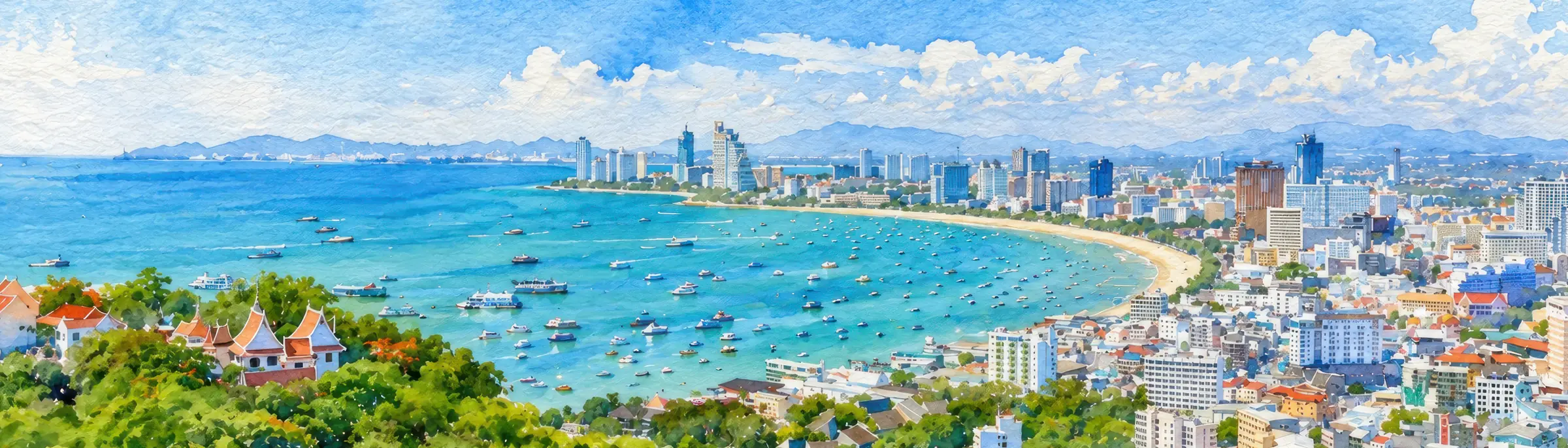
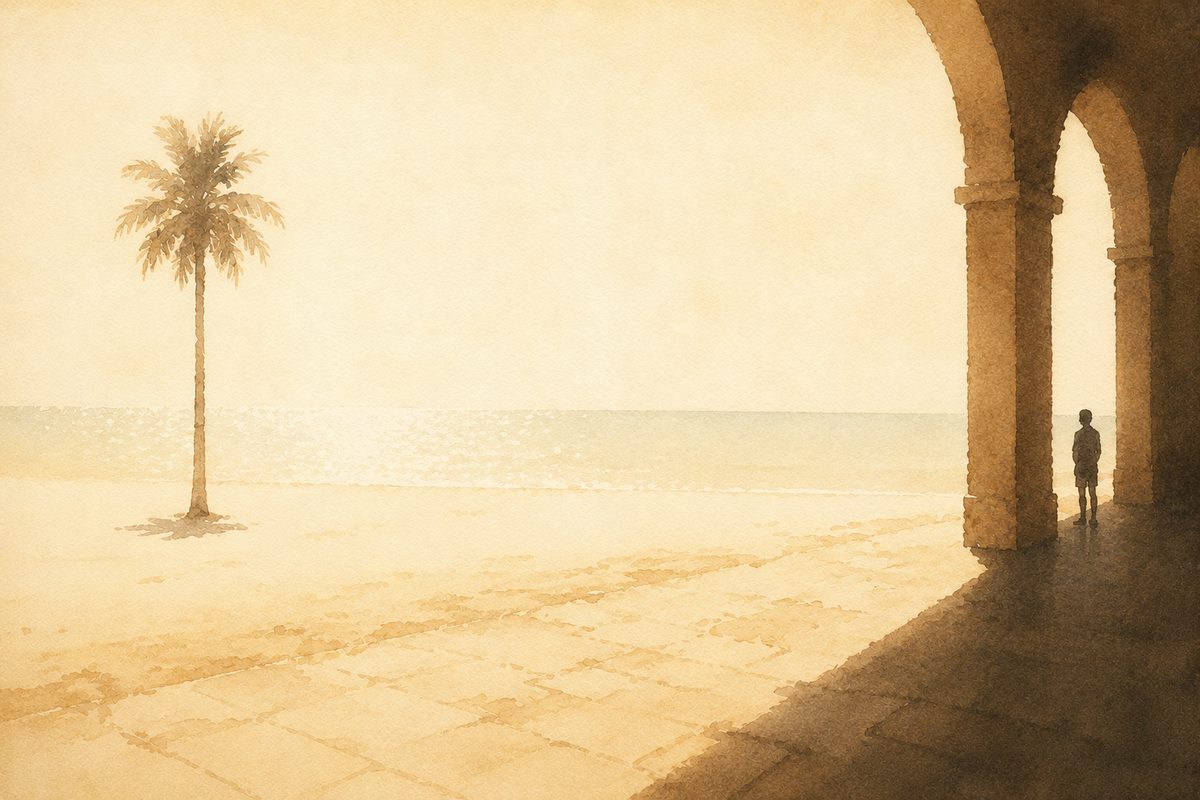
Midday in Pattaya runs from roughly 11:30 a.m. to 2:30 p.m. The sun is nearly overhead, shadows are short and hard, and sand and water act as a second light source from below. It’s the most awkward time of day for a shoot. And that is when most tourist bookings fall: between breakfast and a siesta, after a transfer, before dinner, in a free hour between excursions.
This isn’t a matter of the photographer’s taste. Pattaya lies at latitude 12°, and in late April and mid-August the sun climbs to more than 88° above the horizon, practically the zenith. The light falls straight down, bounces back up off the white sand, and cuts into the frame as diagonal glare off the sea and glass facades. The camera catches four light sources at once, and Lightroom won’t untangle that chaos in the final image: either it was solved on location or it wasn’t.
What happens to the face
When the sun is overhead, the brow casts a deep shadow over the eyes, the nose a hard stripe, and the chin a wedge of darkness on the neck. Meanwhile the cheeks and forehead catch the direct light and blow out into hot spots. The face turns into a mask of contrasting patches.
This isn’t a camera flaw. It’s optics, and optics can’t be corrected in post: eyes that have gone into shadow are in shadow in the RAW file too. You can lift them in editing, but the skin turns gray and blotchy, and anyone looking at the portrait will see it has been doctored.
Then there’s the physical side. In direct sunlight people squint. The corners of the mouth tighten, because it isn’t only the eyes that squint but the whole upper half of the face. A smile turns into a grimace. With children it shows at once; adults hold out longer, but after fifteen minutes they’re just as tired.
What reflects the light
In Pattaya, midday light has three partners. You don’t notice them at work, but they show up in the photo:
Sand. Jomtien’s dry, pale sand throws light back up from below, onto the chin, neck, and nostrils. In photos this gives a strange, upside-down kind of lighting: the top of the face in shadow, the bottom lit. Wong Amat and Pattaya Beach do the same, only more gently, because the sand there is darker.
Water. At noon on a windless day the sea is a glossy surface. With the sun at the right angle, it sends diagonal glare straight into the lens. Under a hazy sky the water goes flat blue; when the surface shines, it breaks up into white patches that the camera reads as overexposure. Those patches can’t be recovered in post, because there’s no data in them.
Glass and tile. Condo balconies, hotel pools, and restaurant terraces all work as mirrors. A window over the client’s shoulder reflects the sun into the frame. Pale tiles around a pool bounce light back onto clothing. A glass door throws in a burst of light from the side that you see only once the picture has been taken.
What a strong photographer does
A strong photographer doesn’t shoot the way they would in the morning, and instead picks one of four options:
Moves into shade. Not just any shade. Palm shade is dappled, and ten seconds later the fronds have shifted and so have the patches on the face. What works is deep, even shade: from a building, a solid overhang, an arch, a stairwell. That’s also where business portraits get shot when you want a calm background without the tourist-postcard look.
Uses fill flash. Sun from above plus flash from the front. The flash fills the shadows under the brows and chin, and you can read the face again. Any commercial photographer has known this technique since their first year. On beach and street shoots in Pattaya you rarely see it: most of the local market works with natural light only, and at midday it shows. An external flash, or at least a reflector, in the portfolio is a signal in its own right.
Puts the harsh light to work. That means contrast, graphic shadows, silhouettes against the sea, a profile with half the face in light and half in shadow. This works for a solo portrait of an adult. It doesn’t work for a family with children: kids can’t hold a pose, and a shot like this depends on precise control of the pose.
Shortens the shoot. It’s the most honest move. If midday yields three to five usable shots instead of twenty, the photographer suggests not stretching the shoot out, or moving it. It shows when you message them: a photographer who knows how to work at midday will offer, unprompted, to start earlier, to take some of the shots indoors, or to finish in half an hour instead of an hour. If they agree to “an hour’s shoot by the sea at 1 p.m.” with no reservations, that’s a bad sign.
What to look for in the portfolio
Anyone can pull off a sunset. An Instagram feed that is wall-to-wall golden hour proves nothing. Look at the daytime shots.
Eyes. In a midday set, are they sunk in black shadow, or squinting? Then the photographer just pointed and shot. If you can see them clearly, the photographer worked with the angle or with flash.
Shadows on the face. At midday there is always shadow under the nose and chin. A hard, sharp line means direct light with nothing done about it. A soft one means shade or fill flash.
White clothing. At midday, white blows out to pure white, with no texture and no folds. If a white shirt or dress in the portfolio still looks like fabric, the photographer has the exposure under control.
Windows in interior shots. Midday interiors are often shot with bright windows in the frame. If you can see what’s outside the window, the exposure is balanced. If the window is a blown-out white patch, the photographer shot on a single meter reading, with no second exposure and no ND filter or flash.
A strong shot next to a failed one. One strong portrait under an overhang proves nothing. If the next shot in the same set, taken in open sun, falls apart, the photographer has no daytime technique, only lucky angles. It shows most clearly in wedding galleries: a ceremony in a garden or on a beach rarely gets ideal light.
When midday shooting just isn’t worth it
Sometimes the right answer is to say no. An open-air wedding at 1:00 p.m. in April or May means an hour of stress for the guests and pictures that are almost guaranteed to be weak. A family shoot with children under five makes no sense at midday: a child will be sunburned in twenty minutes and worn out in ten, and ten shots out of thirty will show a tear-stained face. A business portrait taken outdoors by the sea in daytime light almost always looks like a vacation photo, not a professional one.
If a photographer takes on jobs like these with no reservations, that says more about them than a pretty feed does. A good photographer turns down what they can’t do well. That isn’t being “difficult to work with”; it’s professional discipline. A free hour at noon isn’t always a reason to shoot. Sometimes it’s a reason to go back to the hotel, get some sleep, and meet the photographer tomorrow at seven in the morning.
Midday in Pattaya is a filter. It shows who works with the physics of light and who works only with light that comes ready-made. You can’t tell from a single set. From several sets side by side, daytime ones rather than sunsets, you almost always can.