
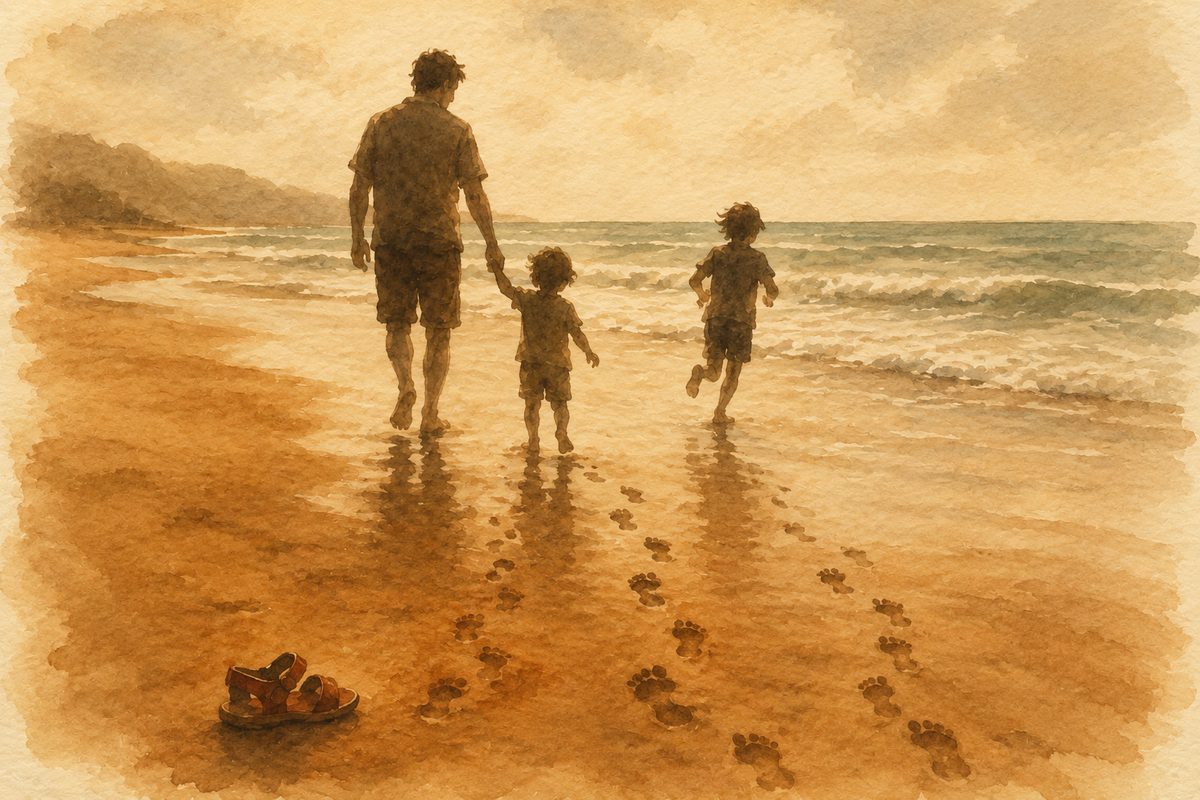
A family shoot on the beach looks like an easy job. Open sea, golden hour, kids by the water. In practice it’s a tangle of heat, sand, tiredness, and the hard-to-predict moods of everyone involved. You have twenty minutes before the older one demands ice cream and thirty before the younger one starts whining. The perfect shot happens between those two marks, and the photographer has to know how to put it together.
Most public family portfolios in Pattaya were shot in the same conditions: 7:00–8:30 in the morning or 5:00–6:30 in the evening, a clean beach with no tourists, children aged 4–10, calm parents. That’s the most convenient window, and it works. The trouble is that real family bookings rarely land in it. More often the shoot has to fit between breakfast and lunch, between the pool and dinner, or into the forty free minutes before the ride to the airport. And that’s when the difference between a strong photographer and a weak one shows immediately.
What a family shoot tests
Children. Age directly sets the plan. A child under three won’t last more than 15 minutes in one place. At five to seven you get 30–40 minutes with one break. A teenager can do an hour, but it takes a photographer who knows how to switch gears. If a photographer agrees to “a one-hour family shoot” with a toddler without a single caveat, that’s a bad sign. An experienced one will offer, unasked, to cut it short or to move half of it into the shade.
The group. A family of two parents and one child is photographed differently from a family of four. With three people in the frame you can play with how they’re turned, the distance between them, and moments between any two of them. With five it becomes a composition problem: everyone has to be visible, nobody hidden behind anyone else, every face in the same light, nobody looking off to the side. Many beach photographers handle a couple well and fall apart with a group. The portfolio shows it at once: the family pictures are mostly “mom, dad, one kid,” and the shoots with grandparents or with two or three children can be counted on one hand.
Sand and water. They aren’t a backdrop; they’re the conditions the photographer works in. Wet sand bounces light up from below and flattens faces. Dry sand works its way under clothes and into hair. The waves change everyone’s pose every five seconds. A child who was dry a moment ago is running around a minute later in soaked shorts. A strong photographer builds all of this into the scene: the wet hem of a pair of shorts becomes a lively shot rather than a flaw. A weak one tries to edit it all out afterward.
Harsh midday light. In Pattaya, family pictures at noon are a genre of their own. On the beach it’s harder still: the sand and the water act as two extra reflectors. On top of that, children tire twice as fast as adults. If a portfolio has daytime family shots where the children’s eyes look normal and their faces are relaxed, the photographer knows what they’re doing. If the family shots were all taken in the morning or the evening, that’s a filter photographers impose on themselves to keep the difficult conditions out.
Pace. A family shoot isn’t about posing. Staged “family portraits,” with everyone smiling straight at the camera, work only when the children are in the mood, which is rare. Good family pictures are half documentary: the kids play, the parents watch, and the photographer catches the moment as it happens. That takes a different way of working, with short bursts, a readiness to react, and as little direction as possible. You can’t see it in a single shot, but in a series it shows right away.
What to look for in family portfolios
Children in unposed moments. Playing, running, talking to a parent, distracted by something. If the portfolio has nothing but staged “family portraits” — everyone standing, everyone looking at the camera, everyone smiling — that’s a format that works 10% of the time. The other 90% come out stiff.
Several children in one shot. Photographing one child is easier than photographing two or three. If the portfolio has only one-child families, the photographer’s ability to work with a group is unproven.
A range of ages. A strong family portfolio has three-year-olds, ten-year-olds, and teenagers in it. Each age needs its own pace. If only the “convenient” 5–8-year-olds are shown, the photographer specializes in cooperative children and may be at a loss with a baby or a teenager.
Shots of the parents on their own. A family shoot often calls for two or three pictures of the couple without the kids, a keepsake for the parents. If the family shoots in a portfolio are all group shots, with none of the parents as a couple, the photographer doesn’t do that part of the job.
Daytime shots on the beach. Daytime, not sunset. If there are none, the photographer says no to difficult conditions and will be severely limited if you ask for a daytime shoot.
What to discuss before the shoot
The children’s ages come first. Then temperament: if a child doesn’t like being photographed, it’s better to say so in advance. Time of day: if the photographer suggests golden hour and that doesn’t suit you, ask about an alternative rather than quietly agreeing to an inconvenient time. Length: an hour with two children under five rarely makes sense, and 30–40 minutes works better. Location: the beach by your hotel or a spot picked for the shoot; the difference in light and in crowds is big.
Clothing is a subject of its own. White fabric on the beach works badly at midday and well at sunset. Bright colors by the water pull attention away from the faces. As for coordinating colors across the family, five identical white shirts look staged and a free-for-all looks chaotic. It’s better to agree on a palette (three or four shades close to one another) than to aim for sameness. A good photographer will sometimes offer tips like these unprompted while you’re messaging.
Then there’s how ready you are for wet feet and sand. If the parents aren’t prepared for clothes to get dirty, the shoot is limited to seated shots away from the water. That works, but it’s duller. If they are, the photographer has a free hand. That’s worth discussing too.
Where to look
There’s no point comparing a family photographer from London or New York with a local one. A local knows Jomtien, knows Wong Amat, knows Naklua, knows where the beach is empty in the morning and where it’s packed after 4:00 p.m. They know that on a Saturday from 5:00 p.m. you can’t shoot at the southern end of Jomtien without a crowd of extras in the frame. Small things like these make or break a shoot, and they take years to learn.
Of the public photographer profiles in Pattaya, about a third clearly specialize in family and couples shoots, about a quarter are mainly wedding photographers, and the rest do a bit of everything, leaning toward vacation shoots. Those are different techniques and different kinds of experience. A wedding photographer can shoot a family decently, but it’s rarely their strong suit. A vacation photographer can turn out good candid shots but sometimes can’t cope with a large group. A purely family photographer is usually the best choice for a family with children — but among the public profiles there are fewer of them than the photographers’ own descriptions suggest.
What a portfolio won’t show
It won’t show patience with a child who doesn’t want to be photographed, or the ability to change course when the plan falls apart. Nor will it show how fast the finished files arrive (for family memories that often matters) or how the photographer deals with requests for changes. All of that shows only when you talk before the shoot and when you meet in person. Some of it can be read from the messages: how much the photographer asks about ages, pace, and limitations. If they ask, the experience is there. If the only reply is a price list, this is photography as a service, with no grasp of the context.
Family photography in Pattaya isn’t a difficult genre, but it does demand attention to detail. Most of the pictures in the final gallery have life in them, and it isn’t beautiful light that does it: the photographer was quick enough to catch the moment between one child’s tiredness and the other’s meltdown. That’s skill, not luck.